
Dickenson County Assessment and Tax Records
Dickenson County splits its online services the same way it splits its records. The county's own description of the card search mentions summary details, improvements, sketches, and photos. These appear where they exist. The same hub also links the real-estate public inquiry, tax payment, and archived cards. It also links tax maps and tax books. What the county does not spell out is the full set of assessed-value fields, exemptions, and tax-district labels. It also leaves open how far back the history goes. Open the live record and see what it actually shows.
| Field | What It Shows | Where |
|---|---|---|
| Assessment card | Summary, improvements, sketch, and photos where available | Commissioner of Revenue property-card service |
| Archived card | Older card image by card number; years are not stated | County archived-card link |
| Real-estate inquiry | Payment history or balance inquiry; coverage years are not stated | County online services / Treasurer |
| Tax maps and books | Parcel reference maps and county tax-book files | PDF/JPG maps and Excel books from county links |
| Delinquent or sale records | Public list or notice status was not verified | Ask the Treasurer or Commissioner; use Clerk records for recorded filings |
An assessed value answers a tax question, not a market one. A buyer's price could differ sharply from the figure on the assessment card. In the same way, a payment-history result only tells you whether an account shows a balance. It may also show a payment entry. It says nothing about whether a deed is valid. Keep valuation, billing, and title questions on separate tracks. That habit pays off when you work through Dickenson County property tax records.
Finding a Dickenson County Tax Bill
Finding a Dickenson County tax bill starts on the official online-services page. Two links matter there: Real Estate Public Inquiry and the tax-payment service. Search by the parcel or by the address tied to the tax account. Then compare whatever comes back against the assessment card. The county treats these as separate services. It publishes no coverage years, no exact payment-search fields, and no fee schedule for them. A missing result is not proof the account is clear. Call or visit the county office first.
- Open the county's Online Services directory and choose Real Estate Public Inquiry or tax payment.
- Use the parcel or address accepted by the service and note the exact account identifier.
- Compare payment information with the separate property card for parcel and assessment context.
- Ask the Treasurer or Commissioner for a current balance, older year, or delinquency status not shown online.
- Assessed value
- A value assigned for the county's assessment process; the local fields and schedule were not verified.
- Tax payment history
- Entries about payments or balance; it is distinct from an ownership record.
- Tax map
- A parcel reference map offered separately from the property card.
- Tax lien
- A claim that may be recorded or tracked through tax and land-record offices; confirm the specific filing.
Dickenson County Assessment Questions
The Commissioner of Revenue page publishes no local reassessment cycle. The county service hub lists no appeal calendar, review-board procedure, or filing deadline. A generic date borrowed from another Virginia locality could easily mislead you here. Start with the current property card. Then ask the Commissioner which value and tax year are under review. Request the county's own instructions for a correction or an appeal. Keep the parcel number, the card page, and any deed or map reference in one file. A factual card detail calls for naming the exact field and supplying the supporting record. A value dispute is different; ask which evidence and which appeal route the county accepts. A countywide average or a map comparison never replaces the office's stated process.
Confirm the local deadline. The research did not verify a Dickenson County appeal date or board. Contact the Commissioner of Revenue for the current year, filing route, required proof, and any review deadline before taking action.
Dickenson County Property Card Search Fields
The county confirms three search modes for the property card. You can search by Owner Name, Parcel Number, or Address. No matching rules or parcel-number format appear anywhere in the published instructions. The archived-card route works differently, using a card number instead. These limits matter in practice. An older parcel may sit on a road whose name has changed, or a prior owner of record may appear under a different spelling.
| Search Field | Type | Confirmed Use | Published Limit |
|---|---|---|---|
| Owner Name | Text | Search mode confirmed on the county service page | Partial-match behavior not stated |
| Parcel Number | Text | Search mode confirmed | Exact syntax not published |
| Address | Text | Search mode confirmed | Street or block results not described |
| Archived Card Number | Separate linked route | Used to reach an archived card | Archive years not stated |
Search and service links are gathered in one place on the Dickenson County Online Services hub.
Dickenson County Commissioner of Revenue
Questions about a property card go to the Commissioner of the Revenue in Dickenson County. The same office handles assessment questions. It sits under county administration at P.O. Box 1098, 818 Happy Valley Drive, Clintwood, Virginia 24228, and the general line is 276-926-1676. No separate direct assessment phone or walk-in schedule is published; start with the main line. Property-card data is hosted in the county e-services system.
The county's Commissioner of the Revenue page is the direct route to the office.
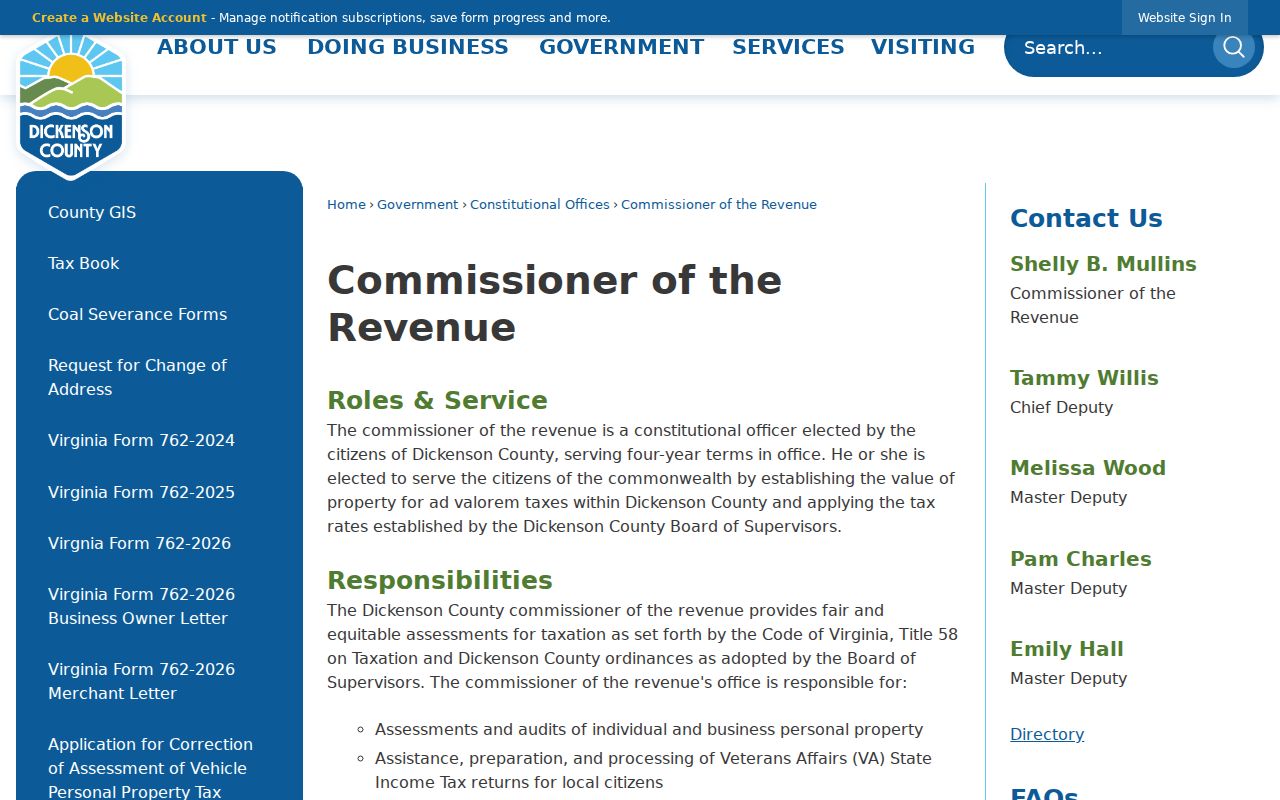
The department responsible for assessment information is identified here, while the linked card system handles the parcel lookups.
Dickenson County Tax Maps and Books
A tax bill is one record. Tax maps and tax books are different records that answer different questions. Through its online-services directory, the county offers map files as PDF or JPG. Tax books come in Excel. A tax map helps you orient a parcel on the ground. A tax book gives a year-based reference for the tax roll. The hub does not state every file year. No map is guaranteed to carry a current parcel layer. Always check the map against the exact parcel number and the deed's legal description. A recorded plat may show lot, block, easement, or revision details. A tax map may leave some of these out. When parcel lines or ownership disagree across tools, ask the Commissioner or the Clerk. Either office can say which record controls the question. The WebGIS viewer is a separate map link with no documented layer dates. The Online Services hub links every map and tax-book format.
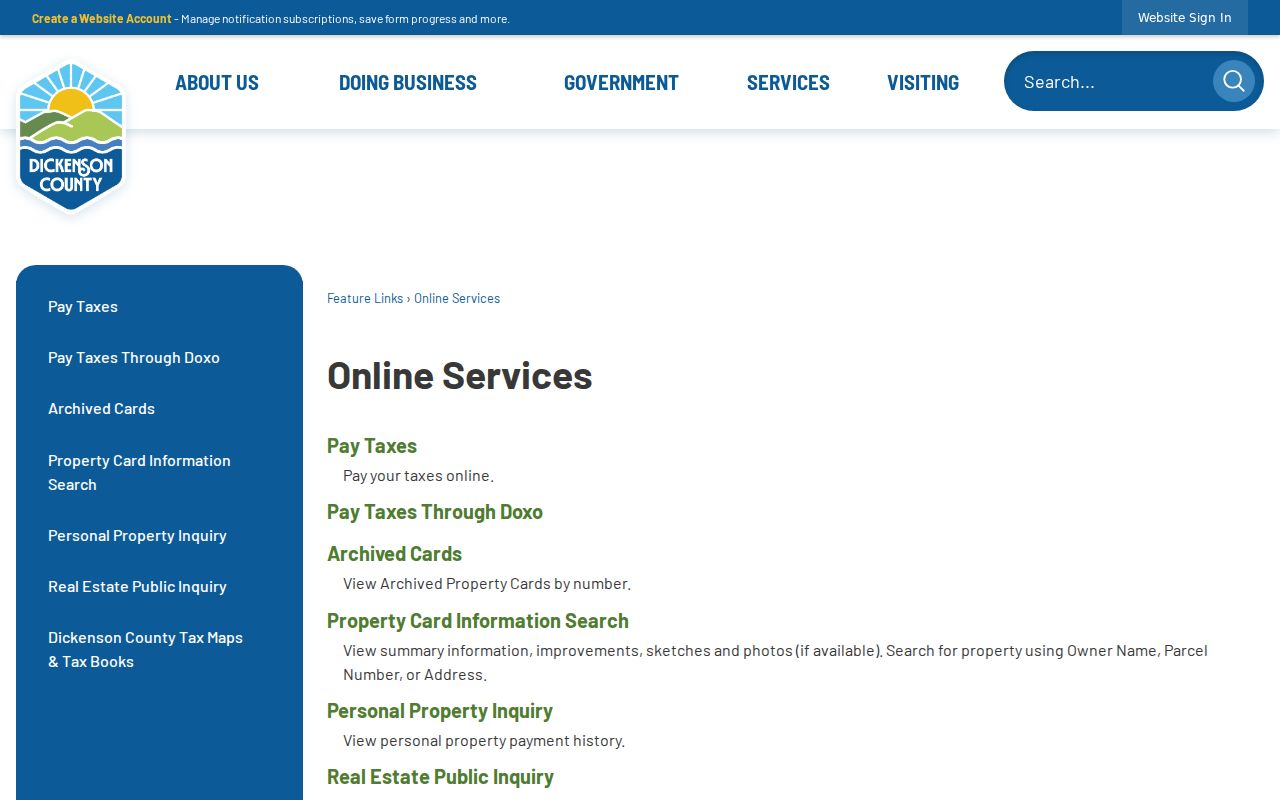
Open the current official files from the hub. Then note the year and format shown for the specific map or book you used.
Dickenson County Delinquent Tax Records
Dickenson County publishes no delinquent-tax list online. There is no tax-sale calendar either. No sheriff-sale portal appears on the county pages. For a current delinquency or notice, contact the Treasurer or Commissioner directly and name the account, year, and parcel. A sale notice may run outside the tax-payment tool, so confirm the current notice route with the county office.
Land records add useful context here. Search the Clerk's records for a tax lien, lis pendens, judgment, or a later trustee's deed. A delinquency notice is not a completed transfer. Confirm the final deed or order, then compare the card for a later owner entry. If an office record is not online, a focused Virginia FOIA request can name the parcel and date range.
Dickenson County Assessment History
Dickenson County links archived property cards. That route differs from both the current card search and the real-estate payment inquiry. The county says the archive is searched by card number. It does not state which years are covered. Ask whether the archive includes the year you need. Ask whether a tax book or older paper file works better when the card number is unknown.
Never merge payment entries with assessment values into one conclusion. A payment can relate to a bill even while the assessment is disputed. A card may show property details without the full payment history. Dickenson County's public pages publish no reassessment schedule or historic value series in text. Request the year-specific record from the custodian rather than inferring change from a current total.
Dickenson County Tax Records and Title
A tax bill proves nothing about ownership. Neither does a balance or a payment receipt. The card may list an owner name for assessment purposes. A deed documents the recorded conveyance. A tax map can help you locate land without proving a boundary. For a purchase, an estate, or a disputed tract, compare the current card with the newest deed. Also compare any recorded plat or court order.
The payment service and land records run through different county routes. Use the real-estate inquiry for a balance question. Use the Circuit Court Clerk for a recorded instrument. The Clerk's copy fees and record access rules apply to the land-record request. They do not apply to a tax payment. Keep the parcel number and legal description consistent as you move between those offices.
Follow a Dickenson County Tax Account Across Services
Start with the property card when the issue is how land or improvements are described for assessment. Then use the separate real-estate public inquiry for a bill, balance, or payment. The county Online Services page also lists a personal-property inquiry. That path is a different account from real estate. A vehicle entry is not a parcel tax record merely because the same county menu links both services.
Keep the card number, tax year, and exact question together. If a payment entry seems inconsistent with a notice, ask the tax-payment custodian to explain the account period and status. If the assessed property itself looks wrong, direct the question to the Commissioner of Revenue. Do not treat a payment screen as the assessment record. The county publishes no universal appeal deadline or single assessment-review calendar. Get the applicable date and procedure from the office before filing.
Older entries sit elsewhere. The county separately links Excel tax books and archived property cards. The public service description says archived cards are searched by card number, without stating their year coverage. Tax-book years and spreadsheet columns are not identified in the public directory. Ask for the exact year and record series you need. Do not assume the online inquiry holds a complete assessment or payment history.
When a property is sold or divided, compare the account with the recorded instrument and map references. A payment record can follow an account number. A deed describes a different legal interest or only part of a tract. If a balance, owner name, or parcel description is disputed, preserve the notice and contact the right county custodian. The Clerk's deed copy schedule applies to recorded land instruments, not to tax-account statements.