
Trace Former Dickenson County Owners
Treat each recorded transfer as one step in the backward chain. The table is a working sequence, not a sample deed. Every party, date, deed type, and book and page must come from the actual instrument. The instrument must cover the parcel being traced. No names or sale facts should be drawn from an assessment card alone.
| Transfer step | Grantor to Grantee | Deed Type | Book and Page |
|---|---|---|---|
| Most recent deed | Copy the parties as recorded | Read the instrument | Use the recorded reference |
| Prior acquisition | Search the prior grantor as grantee | Confirm the deed type | Record the book and page |
| Earlier transfer | Repeat with name and tract clues | Review exceptions | Match the legal description |
| Historic volume | Use the LVA name indexes | Inspect the deed image | Verify the catalog reference |
Start recent transfers with the Clerk and the current parcel record. Older history lives on microfilm. Use the LVA catalog to locate the right reel and its index for the deed books in question. The Clerk's public page names no modern online cutoff. Never assume a web search reaches any particular year.
Walk the Dickenson County Deed Chain Back
Backward work starts from a known transfer. Follow each prior grantor to the deed by which that party acquired the tract. This method beats a street-address search for historic land. Older Dickenson County records may name a hollow, a creek, a ridge, an acreage figure, or an adjoining family instead of a modern situs address.
- Locate the newest relevant deed and copy its grantor, grantee, legal description, and reference.
- Search the grantor as a grantee to find the earlier transfer into that party.
- Compare acreage, tract name, adjoining owners, and exceptions to keep the same land in view.
- Repeat with initials, spelling variants, spouse names, and historical tract terms.
- Move to the LVA microfilm catalog when the online path ends or is unclear.
- Grantor
- The party conveying an interest.
- Grantee
- The party receiving the interest.
- Chain of title
- The ordered set of transfers used to trace recorded ownership.
- Legal description
- The deed's land description, often more stable than a rural street name.
How Far Dickenson County Deeds Reach
Dickenson County formed in 1880. The LVA catalog lists Deed Book 1 covering 1880 to 1886. Early volumes run through Book 16, which reaches 1900. Separate grantor and grantee indexes reach 1972. Those dates reflect verified catalog coverage, and the Clerk publishes no current online cutoff; neither a courthouse loss nor an imaging start date appears in any official account.
Index depth. The modern online deed-index cutoff is not published. The Library of Virginia catalogs Dickenson grantor and grantee indexes through 1972, with earlier deed books and indexes available by reel.
Research before 1880 crosses county lines. A chain that ends at the Dickenson County line is rarely the start of the land's story, so search earlier names and tract references in whichever county held the record at the time.
Dickenson County Microfilm Deed Books
The LVA catalog opens with Deed Book 1 for 1880 to 1886. Book 2 covers 1886 to 1887. Books 3 and 4 both cover 1887. The volumes then run through Book 16, which reaches 1900. Two index sets round it out: general deed indexes cover 1879 to 1893. Separate indexes cover Books 1 through 16, spanning 1880 to 1900.
Find the reel by county and book range before asking a library about interlibrary loan. Record the index entry's name and its book and page. Then pull the deed itself. A name-only match can mislead. Two entries may belong to different people or parcels. Compare acreage, watercourses, adjoining owners, and later exceptions before calling two entries one tract.
The Library of Virginia Dickenson catalog is the official finding aid. It lists the historic land reels.
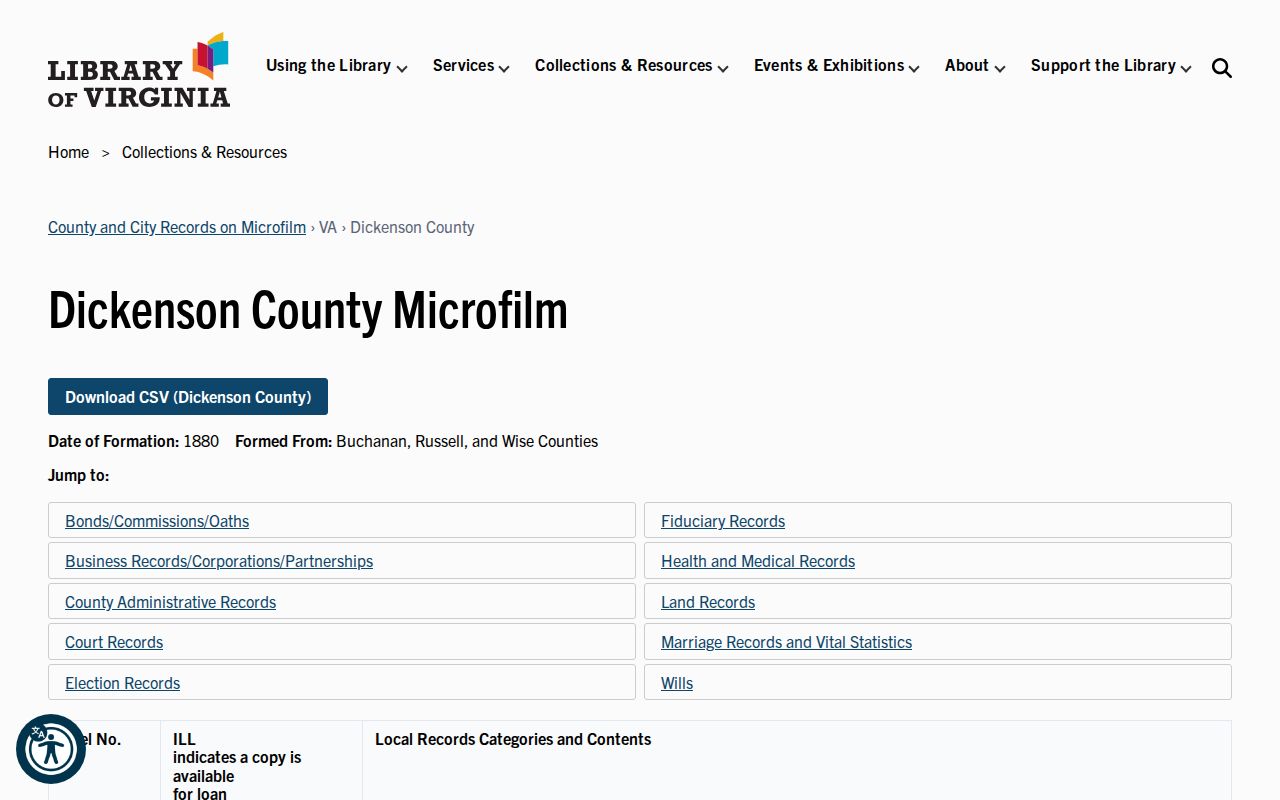
The LVA catalog page shows the path to the older deed indexes. A reel entry still needs confirming against the deed page itself.
Dickenson County Grantor and Grantee Years
The LVA catalog records grantor indexes for Deed Books 1 through 70. These cover 1880 to 1938. Separate grantor and grantee indexes run from 1880 through 1972. That span offers two routes to an old deed. Use the grantor list to follow an outgoing transfer. Use the grantee list to find the deed that put land into a party's hands.
That span has limits. The catalog does not prove every later deed is online. Nor does it mean the Clerk's current index stops in 1972. The county publishes no modern web cutoff for its online deed records. When a name search stalls, ask the Clerk about the office index or an archived record. Lean on the LVA reels for their documented years.
Before Dickenson County Formed
Dickenson County was carved from neighboring counties in 1880. An older chain may sit under a predecessor jurisdiction. First find the earliest Dickenson deed reference for the parcel. Then ask whether the prior conveyance predates the county itself. Which predecessor volume holds the record varies by tract. Match the legal description against county history to choose the right archive.
A deed recorded in the new county may cite an earlier transaction. It may also cite a survey or family claim. Compare names and land calls across both jurisdictions. Common surnames repeat. Spouse names, acreage, adjoining owners, and the grantor or grantee role separate people who share a name.
Dickenson County Probate and Heir Transfers
Former owners do not always connect through a sale. A death changes the path. A deceased owner's interest may pass through a will, a fiduciary file, an order, an executor's deed, an administrator's deed, or a deed from heirs. The Circuit Clerk site links Wills and Probate. The LVA catalog adds fiduciary settlements from 1898 to 1921, a commissioner of accounts book from 1904 to 1930, and fiduciary order books from 1906 to 1938.
Ask the office for the probate file and the land instrument carrying the legal description. Death and marriage indexes aid family research. They cannot establish title. Match names, case dates, and tract descriptions across the probate and deed records before continuing backward through Dickenson County ownership.
Dickenson County Tract and Name Clues
Old deeds in Dickenson County lean on place clues a modern address search will miss. Creeks, branches, ridges, coal seams, acreage calls, and adjoining families all matter. Record every spelling and set of initials exactly as written. Spouses appear under different index forms across books. A common surname can pull in entries from unrelated families.
If a street address goes nowhere, pull the current parcel card first. Its legal description gives you the calls to compare against the deed chain. A plat may pin down a lot or an easement. An older deed may describe only part of a larger tract. Keep every reference with its book and page. Later researchers can then tell a true chain from a same-name coincidence.
A Former-Owner Search Plan for Dickenson County
Work backward one transfer at a time. Start with the newest deed on the parcel. Record the grantee, grantor, date, book and page, and the exact legal description. Then treat that grantor as your next search name. Confirm each earlier instrument describes the same tract, or a documented piece of it. A name match without a matching property description is a warning. It often leads to a different family branch or a neighboring parcel.
Dickenson County's historic catalog gives you a defined starting range. Deed Book 1 opens in 1880, and the early books reach Book 16 by 1900. The Library of Virginia catalog lists grantor and grantee indexes through 1972. It also includes older index runs from the county's first years. That range does not mean every later deed is online, or that indexing stopped in 1972. Ask the Circuit Court Clerk how to reach later transactions. Also ask whether a needed book or copy is held locally.
Log everything in a chain worksheet. Track book references, dates, party roles, acreage, and adjoining owners. An estate sale deserves a side trip into the fiduciary or probate file. There the land instrument and the estate papers should agree. If your chain runs before 1880, the land likely sat in a predecessor jurisdiction. Continue the search there. The county's formation date marks an administrative change, not a break in the property's history.
For copies, the Clerk lists plain pages at 50 cents each. Certification adds $2 per document. Confirm current fees and procedures before you visit or mail a request. Remember that an index entry only locates the record. The full instrument, with its legal-description pages and any referenced plat, is what proves which interest actually changed hands.